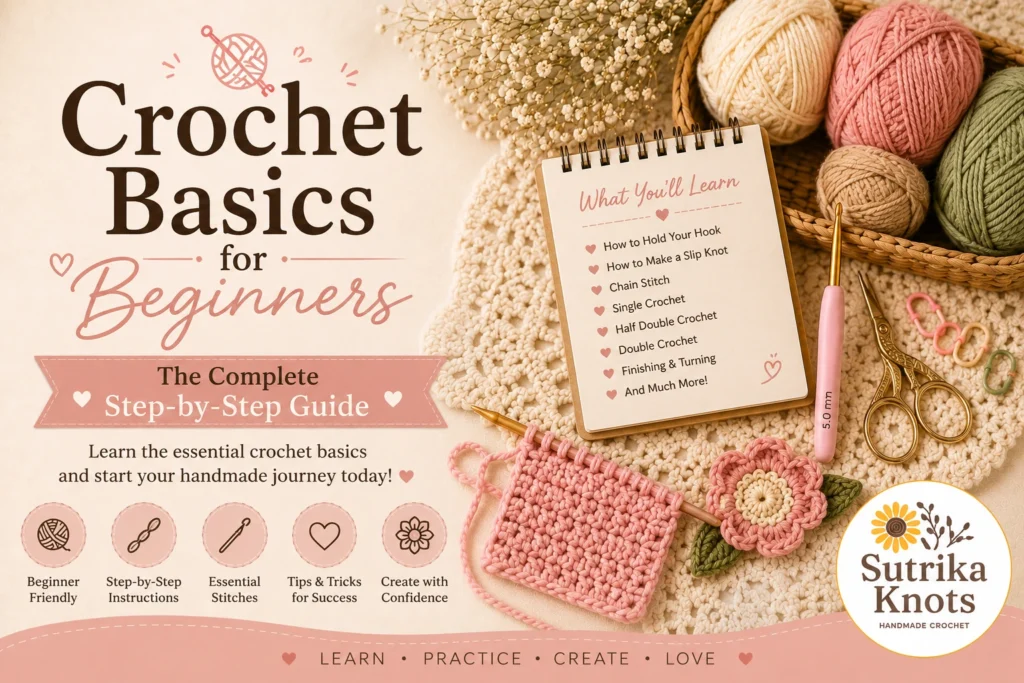
Every crocheter, no matter how advanced, started with the same handful of basics: how to hold the hook, how to make a slip knot, and how to chain. This guide walks through those crochet basics for beginners in order, so you can go from an empty hook to your first finished piece without getting lost in advanced terminology too early.
Getting Started: What You Need Before Your First Stitch
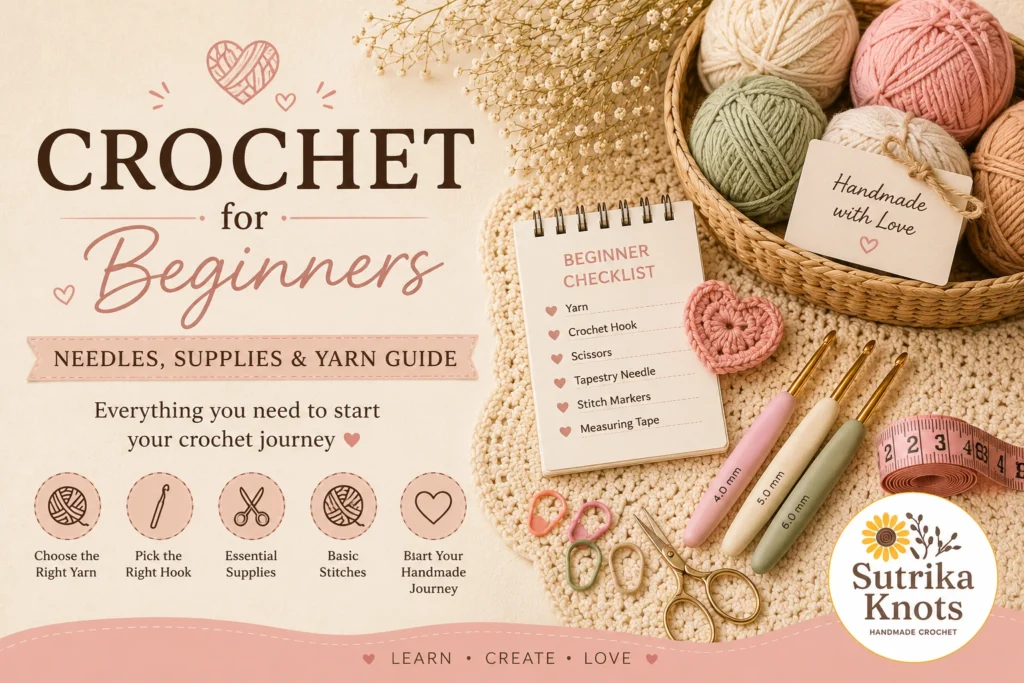
Before learning any stitches, gather the essentials:
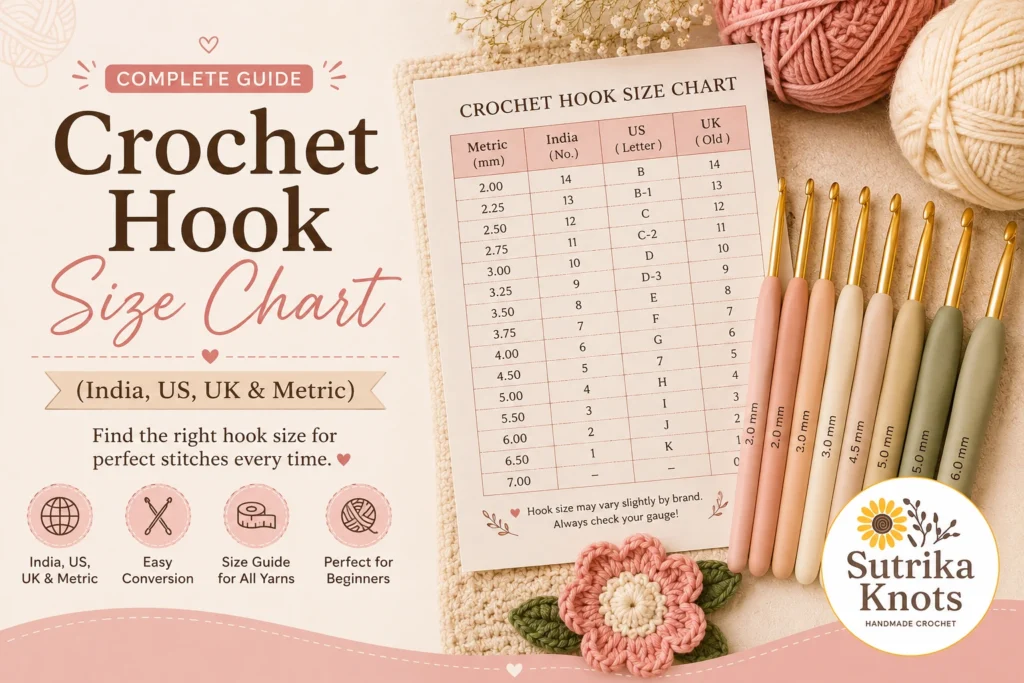
- A 4mm–5mm crochet hook (large enough to see stitches clearly)
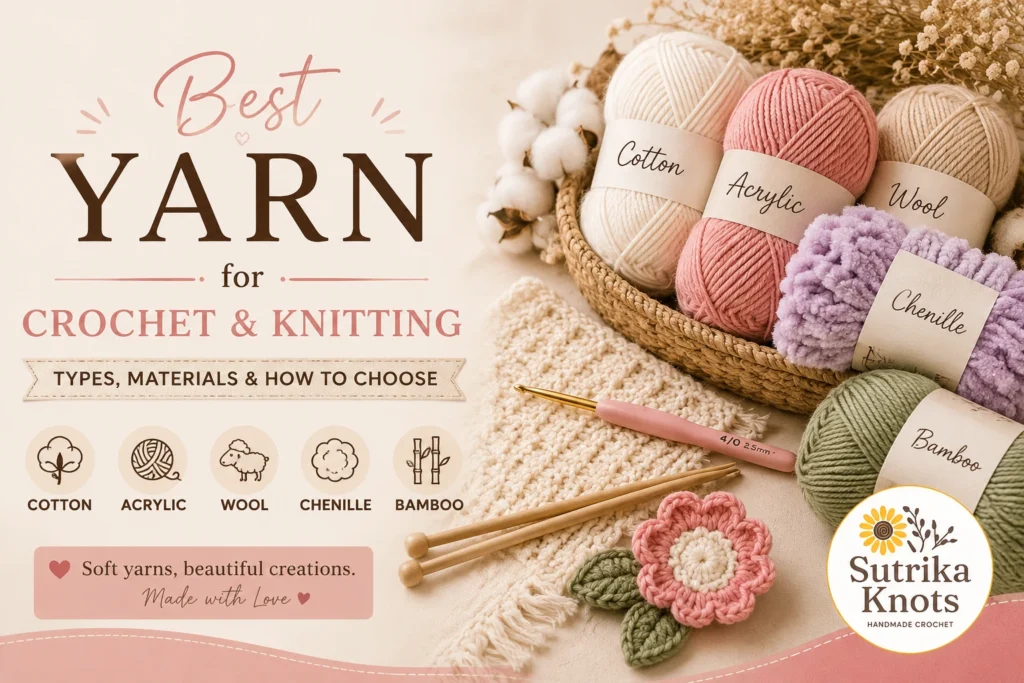
- A worsted or DK weight yarn, in a light solid colour
- A pair of scissors
- A tapestry needle for weaving in ends
Avoid dark, fuzzy, or multicoloured yarn for your first practice piece — it makes it much harder to see individual stitches while you’re still learning to read your work.
How to Hold Your Hook and Yarn
There’s no single “correct” grip, but two common hook holds work well for beginners:
- Pencil grip: hold the hook the way you’d hold a pen, between your thumb and index finger
- Knife grip: hold the hook overhand, the way you’d hold a knife
For yarn control, most beginners weave the working yarn loosely through the fingers of their non-dominant hand to create light, even tension — enough resistance to control the yarn without pulling so tight that stitches become difficult to work.
Crochet Basics, Step by Step
1. Make a Slip Knot
Every crochet project starts with a slip knot placed on the hook — this is your first loop and the foundation for everything that follows.
2. Chain Stitch (ch)
The chain stitch is the very first stitch every crocheter learns. Made by pulling a loop of yarn through the loop already on your hook, a row of chains forms the foundation row for most crochet projects.
3. Single Crochet (sc)
The single crochet is the shortest, tightest basic stitch. It’s worked by inserting the hook into a stitch, pulling up a loop, then pulling through both loops on the hook. This stitch creates a dense, sturdy fabric — ideal for amigurumi, coasters, and bags.
4. Double Crochet (dc)
The double crochet is taller than single crochet and works up faster, since each stitch involves an extra yarn-over before you begin. It creates a looser, more open fabric — commonly used for blankets, scarves, and garments.
5. Slip Stitch (sl st)
The slip stitch is the shortest stitch of all, mainly used to join rounds, move across stitches without adding height, or finish off an edge neatly.
6. Turning and Working in Rows
Once you can chain and work single or double crochet, the next basic skill is turning your work at the end of a row and continuing back across it — this is how flat pieces like scarves and dishcloths are built up.
Crochet Basics Cheat Sheet
| Stitch | Abbreviation | Height | Common Use |
| Chain | ch | Foundation | Starting row for most projects |
| Slip stitch | sl st | Shortest | Joining rounds, finishing edges |
| Single crochet | sc | Short | Amigurumi, coasters, bags |
| Half double crochet | hdc | Medium | Garments, blankets |
| Double crochet | dc | Tall | Blankets, scarves, quick projects |
Your First Practice Project
Once you’re comfortable with chain and single crochet, try this simple sequence to build real confidence:
- Chain 15–20 stitches
- Work a row of single crochet across
- Chain 1, turn, and repeat for 8–10 rows
- Finish off and weave in your ends
This simple swatch teaches tension, turning, and finishing — the three skills every later project builds on.
Finding Crochet Classes for Beginners
If you’d rather learn with guidance than figure things out solo, there are a few good options for crochet classes for beginners:
- Online video tutorials — flexible, free or low-cost, and easy to pause and rewatch a tricky step
- Local craft studios or yarn stores — often run in-person beginner workshops with hands-on correction, which can be faster for catching grip or tension issues early
- Community groups — crochet circles or local maker meetups are a low-pressure way to learn alongside others and ask questions in real time
Whichever format you choose, look for a class or series structured around the same basics covered above — slip knot, chain, single crochet, and double crochet — since these fundamentals carry into almost every pattern you’ll try afterward.
Common Beginner Mistakes to Avoid
- Counting stitches incorrectly — miscounting your starting chain is one of the most common early mistakes; recount before starting your first row.
- Gripping the yarn too tightly — this causes hand fatigue and uneven stitches; aim for light, consistent tension.
- Skipping the first or last stitch in a row — a common cause of a project slowly narrowing without you noticing.
- Moving to complex patterns too soon — spend real time on the basics above before attempting garments or detailed motifs.
FAQs: Crochet Basics for Beginners
What are the basic crochet stitches to learn first? Start with the chain stitch, single crochet, and double crochet — these three cover the majority of beginner patterns and form the foundation for every other stitch.
How do I hold a crochet hook as a beginner? Most beginners use either a pencil grip (holding the hook like a pen) or a knife grip (holding it overhand); try both and use whichever feels more comfortable and controlled.
What is the first stitch every beginner should learn? The chain stitch, since it’s used to create the foundation row for nearly every crochet project before any other stitch is worked.
Are online crochet classes as good as in-person ones for beginners? Both work well — online tutorials are flexible and easy to rewatch, while in-person classes offer hands-on correction that can help catch grip or tension issues faster.
How long does it take to learn crochet basics? Most beginners feel comfortable with slip knots, chains, and single crochet within a few practice sessions, and can complete a simple swatch or coaster within their first week of regular practice.
What should my first crochet project be? A simple flat swatch or coaster using chain and single crochet stitches is the easiest starting project — it builds tension and turning skills without the complexity of shaping.
Ready to see these basics in finished form? Browse Sutrika Knots’ handmade crochet flowers, bouquets, and keychains — or explore custom orders if you’d like something made to your own design.