If you’ve searched “what is 4 ply” or “four ply meaning,” you’ve probably run into two different answers on the internet — and both sound confident. That’s because “ply” gets used two different ways depending on where the yarn comes from, and most guides only explain one of them.
This guide gives you the complete picture: the technical meaning of ply, the everyday (mostly UK/Australian) meaning of “4 ply” as a yarn weight, and exactly which one to trust when you’re picking yarn for a pattern.
What Does “Ply” Actually Mean?
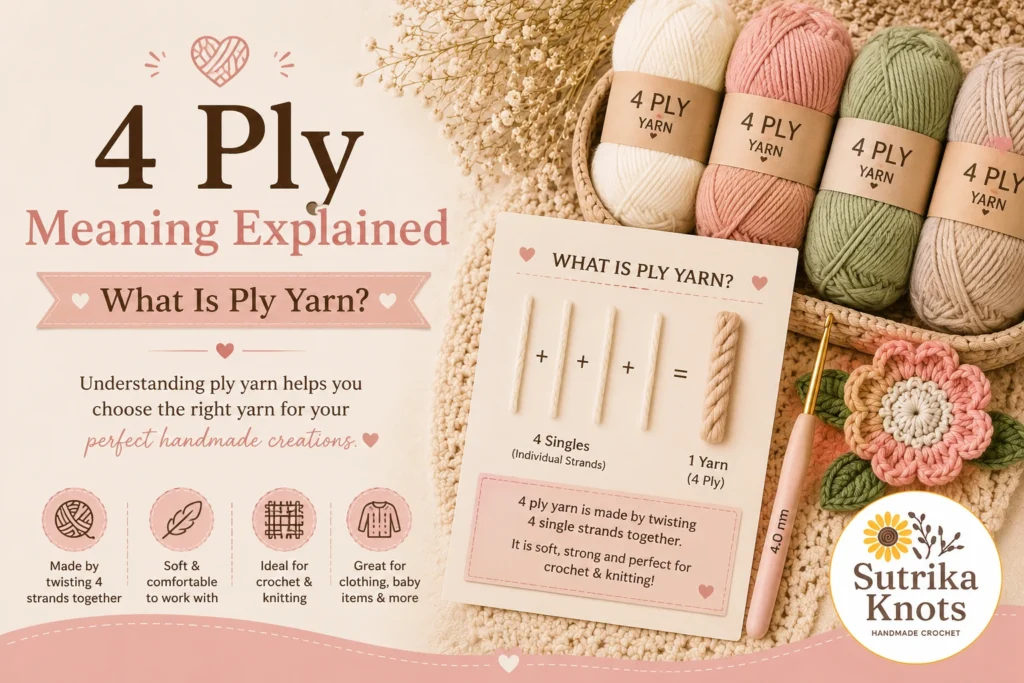
In its original, technical sense, ply refers to the number of individual strands twisted together to form one piece of yarn. A single strand on its own is unstable and prone to splitting — twisting several strands together makes it stronger, rounder, and easier to work with.
- A 2-ply yarn is two thin strands twisted together
- A 4-ply yarn is four thin strands twisted together
- An 8-ply yarn is eight thin strands twisted together
Under this definition, ply describes construction, not thickness. You can twist four very fine strands into a thin 4-ply yarn, or four thick strands into a much heavier 4-ply yarn — the strand count alone doesn’t tell you how thick the final yarn is.
The Other “4 Ply Meaning”: Ply as a Yarn Weight Category
Here’s where the confusion comes in. In the UK, Australia, and New Zealand, “4 ply” is also used as a named yarn weight category — similar to how “DK” or “Aran” work as weight names. In this everyday usage:
- 4 ply roughly corresponds to a light, fingering-weight yarn
- 8 ply roughly corresponds to a DK (double knitting) weight yarn
- 12 ply roughly corresponds to an Aran or worsted weight yarn
So when a UK or Australian pattern calls for “4 ply yarn,” it’s telling you the thickness category to buy — not necessarily how many strands are physically twisted together. A yarn label might say “4 ply” and be made of a different actual strand count, because the term has become shorthand for a weight, much like “medium” or “large” on a clothing tag.
In short:
- Ply (technical) meaning = number of twisted strands
- Ply (common/regional) meaning = a yarn thickness category, mostly used in UK/Australian sizing
Ply Yarn vs. Yarn Weight: Quick Comparison
| Term | What It Describes | Does It Guarantee Thickness? |
|---|---|---|
| Ply (strand count) | How many strands are twisted together | No |
| Ply (weight name, e.g. “4 ply”) | A regional thickness category | Roughly, within that region’s convention |
| Yarn weight (Fine, DK, Aran, Bulky) | International thickness standard | Yes — this is the most reliable label |
4 Ply / 8 Ply / 12 Ply — Approximate Weight Equivalents
If you’re converting a UK or Australian pattern’s ply terminology into the international yarn-weight system, use this as a general guide:
| Regional Ply Name | Approx. International Weight | Typical Hook/Needle Size |
|---|---|---|
| 2 ply / 3 ply | Lace / Fingering | 2.0–2.75 mm |
| 4 ply | Fingering / Sport | 2.75–3.5 mm |
| 8 ply | DK (Double Knitting) | 3.5–4.5 mm |
| 10 ply | Worsted | 4.5–5 mm |
| 12 ply | Aran | 5–5.5 mm |
| 14 ply+ | Bulky | 5.5 mm+ |
Important: these are approximate, not fixed rules — always check the yarn label’s actual weight category or gauge information rather than relying on the ply number alone, since ply-to-weight matching isn’t standardized across brands.
Why This Matters When You’re Choosing Yarn
If you only look at the ply number on a label, you can end up buying the wrong thickness for your pattern. The safer approach:
- Check the yarn weight name first (Lace, Fingering, DK, Aran, Bulky) — this is the most consistent indicator across brands and countries.
- Check the recommended hook/needle size on the label — this tells you exactly what the manufacturer intends the yarn to be used with.
- Treat the ply number as a secondary clue, useful mainly when you’re working from an older UK/Australian pattern that references ply directly.
Does Ply Affect Anything Else Besides Thickness?
Yes — even when two yarns are labelled the same weight, their ply construction can still affect:
- Stitch definition: yarns with more plies often show stitch texture more clearly.
- Strength and durability: more strands twisted together generally make a stronger yarn.
- Feel and drape: plied yarns tend to feel smoother and rounder than single-strand (unplied) yarns of the same weight.
So ply isn’t meaningless — it just isn’t the number you should rely on to match a pattern’s required thickness.
FAQs: 4 Ply Meaning & Ply Yarn
What does 4 ply mean?
4 ply can mean two things: technically, it’s yarn made from four strands twisted together; in UK/Australian yarn labelling, “4 ply” is also used as the name for a light, fingering-to-sport weight yarn category.
What is four ply yarn used for?
Four ply yarn is commonly used for lightweight projects like baby garments, socks, shawls, and fine-detail crochet or knitting where a thinner fabric is needed.
Is 4 ply the same as DK yarn?
No. 4 ply is generally lighter than DK (double knitting) yarn. In the regional ply-naming system, 8 ply is closer to DK weight, while 4 ply sits in the fingering/sport range.
Does a higher ply number always mean thicker yarn?
Not necessarily. Ply describes the number of strands twisted together, and different manufacturers use different strand thicknesses, so a higher ply count doesn’t guarantee a thicker finished yarn. Always check the yarn weight label alongside the ply number.
Shopping for the right yarn weight for your next project? Explore [Sutrika Knots’ crochet essentials] or browse our handmade flowers, bouquets, and keychains made with carefully matched yarn weights for consistent, professional results.