If you’ve ever picked up a pattern and seen “use a 4mm hook” in one place and “use a G hook” in another, you already know the problem — crochet hook sizes aren’t labelled the same way everywhere. A hook bought in India might be marked in millimetres, while a US pattern calls for a letter, and a UK pattern uses yet another number entirely.
This guide gives you one clear crochet hook size chart covering metric, US, and UK sizing, explains how crochet hooks are measured, and helps beginners pick the right hook for their yarn and project — without the guesswork.
Why Crochet Hook Sizes Are So Confusing
There’s no single global standard for crochet hook sizing. Three systems are in common use, and none of them line up neatly:
- Metric (mm): measures the actual diameter of the hook shaft. This is the most reliable system because a millimetre is a fixed unit everywhere — including in India, where most hooks sold locally are labelled this way.
- US sizing: uses a mix of letters (B, C, D…) and numbers, based on older manufacturing conventions rather than a strict measurement.
- UK sizing: uses numbers that run in the opposite direction of US numbering — a bigger UK number means a smaller hook.
Because patterns are written by designers from different countries, you’ll see all three systems used interchangeably. The safest habit is to always check the millimetre size first, since that’s the one true constant.
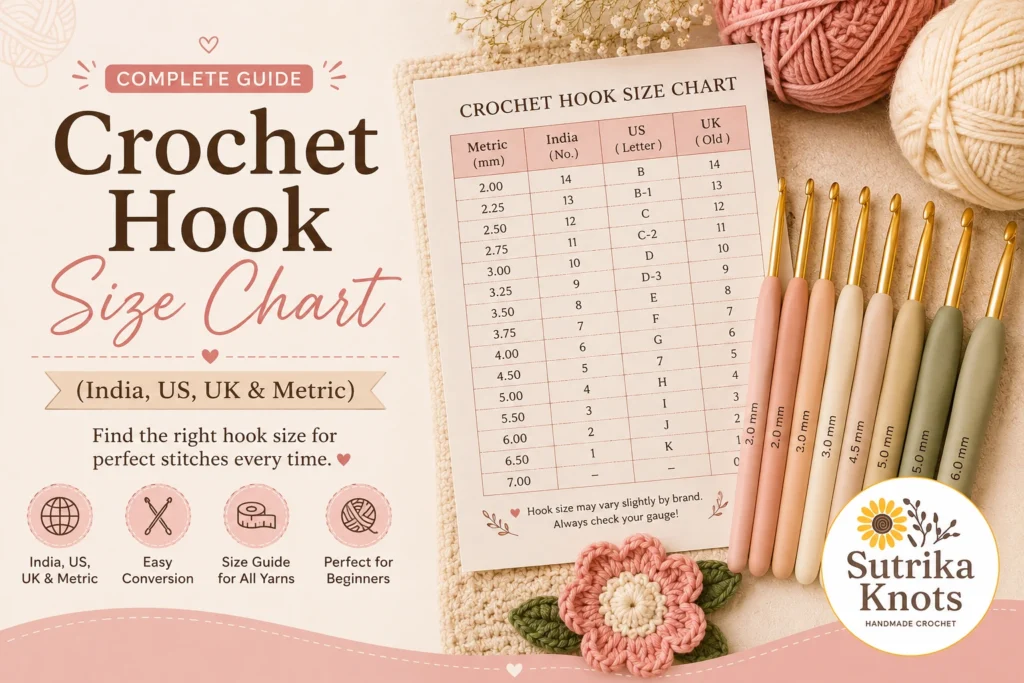
Crochet Hook Size Chart (Metric, US & UK Conversion)
Use this chart to convert between sizing systems and find the matching hook regardless of where the pattern was written.
| Metric (mm) | US Size | UK Size | Common Use |
|---|---|---|---|
| 2.0 mm | B/1 | 14 | Thread crochet, fine lace |
| 2.25 mm | B/1 | 13 | Doilies, amigurumi with fine yarn |
| 2.5 mm | – | 12 | Fine cotton, small motifs |
| 2.75 mm | C/2 | 12 | Amigurumi, keychains |
| 3.0 mm | – | 11 | Lightweight cotton, flowers |
| 3.25 mm | D/3 | 10 | Sport-weight yarn |
| 3.5 mm | E/4 | 9 | DK yarn, everyday projects |
| 3.75 mm | F/5 | 9 | DK yarn, garments |
| 4.0 mm | G/6 | 8 | Worsted yarn, bags, coasters |
| 4.5 mm | 7 | 7 | Worsted yarn, blankets |
| 5.0 mm | H/8 | 6 | Aran yarn, sweaters |
| 5.5 mm | I/9 | 5 | Bulky yarn, home décor |
| 6.0 mm | J/10 | 4 | Bulky yarn, quick makes |
| 6.5 mm | K/10.5 | 3 | Chunky yarn, rugs |
| 8.0 mm | L/11 | 0 | Super bulky yarn |
| 9.0 mm | M/13 | 00 | Jumbo yarn, blankets |
| 10.0 mm | N/15 | 000 | Jumbo yarn, arm crochet |
Tip: Indian yarn labels almost always list hook size in millimetres, so when you’re shopping locally, match the mm size on the yarn band directly to the mm column above — you don’t need to convert at all.
How Are Crochet Hooks Measured?
A crochet hook is measured by the diameter of its shaft — the smooth cylindrical part that determines the size of each loop you pull through. This is measured in millimetres using either a hook gauge tool or digital calipers.
The shaft diameter is what matters, not the length of the hook or the size of the handle. Two hooks with completely different handle designs (ergonomic grip vs. straight aluminium) can still be the exact same working size if their shaft diameter matches.
This is also why the hook size chart stays consistent across brands — a 4mm hook from one brand should behave the same as a 4mm hook from another, even if the head shape or handle differs slightly.
Crochet Hook Sizes for Beginners: Which One Should You Start With?
If you’re new to crochet, don’t start with the smallest or largest sizes — both are harder to control. A 4mm to 5mm hook paired with a medium-weight (worsted/DK) cotton or acrylic yarn is the easiest combination to learn on, because:
- The stitches are large enough to see clearly
- Tension is easier to keep even
- Most beginner patterns (coasters, flowers, keychains) are written for this range
Once you’re comfortable with basic stitches, you can move to finer hooks (2.5mm–3.5mm) for delicate work like amigurumi and flowers, or larger hooks (6mm+) for chunky home décor pieces.
Crochet Hook, Needle & Yarn: How They Work Together
Your crochet needle and yarn pairing matters as much as the hook size itself. Yarn weight (its thickness) is usually matched to a recommended hook size range printed on the yarn label:
| Yarn Weight | Recommended Hook Size |
|---|---|
| Lace / Fingering | 2.0 – 3.0 mm |
| Sport / DK | 3.25 – 4.0 mm |
| Worsted / Aran | 4.5 – 5.5 mm |
| Bulky | 5.5 – 6.5 mm |
| Super Bulky / Jumbo | 8.0 mm+ |
Always crochet a small test swatch before starting a project. Everyone’s tension is slightly different, so if your swatch comes out tighter or looser than the pattern’s gauge, adjust your hook size up or down by 0.5mm rather than changing your grip.
Quick Reference: Crochet vs Knitting Needle Sizes
Crochet hooks and knitting needles are sized on different scales even though both use millimetres, because a knitting needle only needs to hold a stitch while a crochet hook needs to both hold and pull yarn through it. If you work with both crochet and knitting needles, always check the mm size specifically for the tool type, not just the number — a “size 8” can mean different things in knitting vs. crochet.
FAQs: Crochet Hook Sizes
What is the standard crochet hook size chart?
The standard chart runs from 2.0mm (fine thread work) to 10mm+ (jumbo yarn), with corresponding US letter/number sizes and UK numeric sizes at each step, as shown in the conversion table above.
What size crochet hook is best for beginners in India?
A 4mm to 5mm hook is the easiest starting point, paired with worsted or DK weight cotton/acrylic yarn — this size range is used in most beginner patterns and keeps stitches easy to see and control.
Are Indian crochet hook sizes the same as US or UK sizes?
Indian hooks are typically labelled in millimetres, which is the universal measurement. To match a US or UK pattern, simply find the equivalent mm size on the conversion chart rather than looking for a matching letter or number.
How do I know what size hook to use for my yarn?
Check the yarn label — most yarns list a recommended hook size range. If unlisted, match the yarn weight (lace, DK, worsted, bulky) to the hook size chart above.
Does hook material affect the size?
No. Aluminium, bamboo, and ergonomic hooks all follow the same mm sizing — material affects grip and glide, not the actual working size.
Can I use a different hook size than the pattern recommends?
Yes, as long as your gauge swatch matches the pattern’s stated gauge. Going up or down by 0.5mm is a common adjustment for tension.
Looking for hooks in these sizes? Browse Sutrika Knots’ crochet essentials or explore our handmade flowers, bouquets, and keychains made using the techniques covered in this guide.